The dead remain present among the living
The Pale Blue EyeThe dead remain present among the living is a governing idea in the novel, but not a settled claim about ghosts. The departed return through memory, dreams, meaningful objects, and Augustus Landor’s later visions of familiar people. These forms of presence are at once consoling and unsettling: they keep relationships active after death, while making it difficult to draw a firm boundary between remembrance and encounter.
Forms of Presence and Their Limits
The idea first takes emotional form in Landor’s account of sleeping alone. He remembers how sharing a bed once felt uncomfortable, yet, years after the loss of a companion, he still cannot occupy the whole bed or use all the blanket. His ordinary habits preserve an absence: grief is legible not through a dramatic vision but through the small adjustments by which he continues to make room for someone who is gone. When his companion distinguishes that loss from Amelia, Landor adds that Amelia is gone too. The exchange keeps the identities and losses distinct while showing how more than one bereavement shapes his present life.
The novel also gives the dead a place in waking consciousness without confirming that they have returned in any literal sense. Landor says that time, under pressure, seems to fold, bringing people from different generations into the same space and making the categories of living and dead inadequate to describe their continuing relations. His account presents this as a way of thinking rather than proof of an afterlife. The novel sustains that uncertainty: the visitors and remembered figures matter to him, but their presence is conveyed through his perspective.
Dreams, Guilt, and the Unfinished Dead
Landor’s recurring attention to Leroy Fry’s remains illustrates how the physical dead persist within the routines of the living. After conversations with Hitchcock, Landor visits Fry’s body at the West Point hospital. He retrospectively describes these visits as a test of his own constitution. Dr. Marquis has begun using potassium nitrate to preserve the corpse, so the visits place material preservation beside Landor’s less tangible effort to understand Fry’s death. The body is still an object of investigation, but it also occupies a recurring place in Landor’s private consciousness.
That night, Fry appears in a dream transformed: the signs of death are absent, he wears officer blue rather than cadet gray, and he carries charcoal and a cage of blue-eyed birds. The birds repeat a promise of silence, while a woman’s singing and the West Point drums enter the dream as additional sounds. Landor calls the experience fancy, yet also describes sleep as precarious and wonders whether his time at West Point had become one continuous movement between dreaming and waking. The disclaimer does not cancel the dream’s force. Instead, the dream makes Fry’s unresolved presence part of the same unstable mental world in which memory, investigation, and sleep overlap.
A related return occurs when Landor interprets Edgar Allan Poe’s reflections on the dead as evidence of a private guilt. He argues that Poe’s language points to his mother and to the fear that forgetting her amounts to harming her again. Landor ultimately rejects the murder accusation he had attached to that language, describing Poe instead as a son unable to stop loving his mother. This is Landor’s interpretation, not independent proof of Poe’s inner life. Its importance lies in the way the encounter makes bereavement and remembrance resemble a confession, then separates emotional guilt from criminal guilt.
Objects That Carry the Past Forward
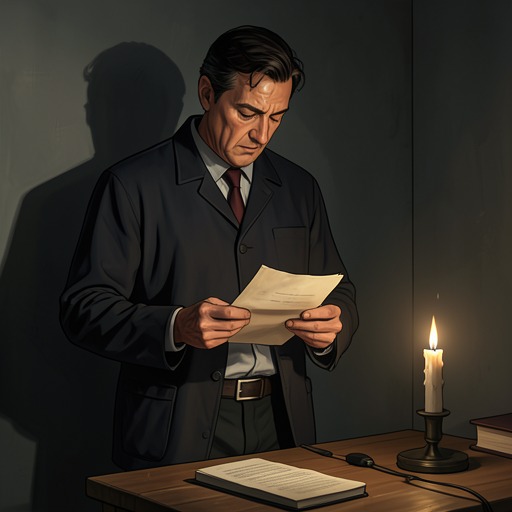
After his daughter’s death, Landor opens a volume of Byron’s poetry because she had loved it and finds a chain she had kept hidden inside. She had taken it from one of the men involved in an attack at a ball and held on to it; attached to the chain is a lozenge-shaped brass plate bearing the arms of the Corps of Engineers. The object turns memory into evidence. Landor considers whether his daughter meant him to find the chain and use it, and the discovery helps set his subsequent course of action in motion.
The chain’s significance is not that it brings the daughter back, but that her past continues to act through something she left behind. The book that once belonged to her, the concealed token, and the father’s interpretation of its placement form a chain of connection between affection, loss, and investigation. The narrative does not make the object speak for itself: its meaning depends on Landor’s reading of it. In that respect, remembrance can preserve a bond and direct action, while remaining entangled with uncertainty about what the dead intended.
The Dead in Landor’s Present
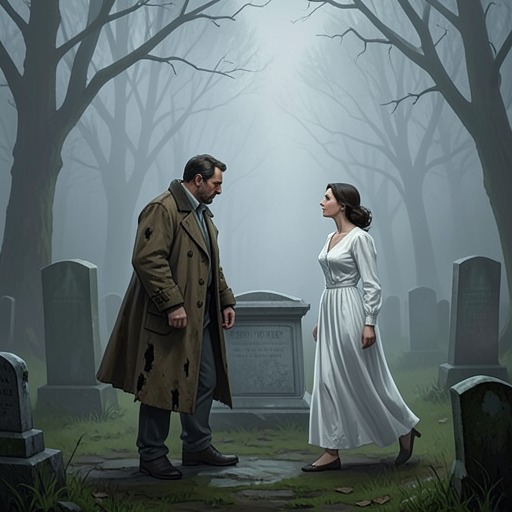
In the epilogue, Landor describes a succession of visitors from his past: Tommy Corrigan, Naphthali Judah, Alderman Hunt, his mother, his old Newfoundland retriever, and his wife. He notes that these familiar figures carry on with ordinary concerns rather than appearing as agents of heaven or hell. They take up little space and mostly leave him to his work. Their presence is therefore not simply a spectacle; it is a continuation of the everyday relationships and habits that made them part of his life.
Landor’s image of time folding brings these appearances into a wider pattern. In his account, Lea studies at the foot of Henri le Clerc, Poe writes verses with Mattie, and Landor talks with people from other periods of his own life. The scenes place different generations and losses alongside one another without making them chronologically simultaneous in any ordinary sense. They express a perspective in which the dead remain consequential because the living continue to remember, speak about, and imagine them.
This vision offers Landor comfort as well as an acknowledgment of mortality. He finds it heartening that his visitors continue the business of life, wonders whether they will remain after he is gone, and allows that Mattie might be there too. As he approaches the end, the possibility of joining them makes that end easier to contemplate. The novel’s final treatment of continuing presence thus holds two meanings together: grief keeps the absent close, and the imagined company of the dead gives Landor a way to face his own death without claiming that loss has been undone.